
Fire Hydrant Testing in Birmingham City Centre
Dry Riser One Ltd was recently appointed by a new client to carry out a comprehensive fire hydrant inspection, flow test and condition assessment in Birmingham City centre.
The project involved the inspection and testing of seven fire hydrants positioned across the area. Our engineer, alongside our project manager from Dry Riser One Ltd attended site to establish the operational condition of each hydrant, assess accessibility and physical condition, record available flow and pressure where testing was possible, and identify any defects requiring further investigation or remedial action.
For a new client, the objective was not simply to complete a routine hydrant test. The priority was to provide a clear technical picture of the hydrant network so that the client could understand which assets were operating correctly, where intervention was required and which issues should be prioritised.
Seven Fire Hydrants Assessed Across the Area
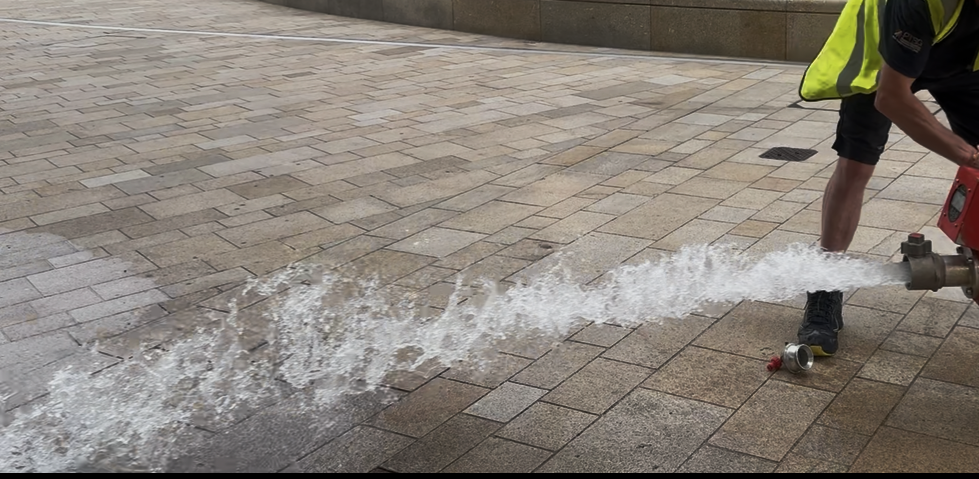
Each hydrant was individually located and assessed by our engineer. Three of the hydrants were successfully tested and recorded as serviceable. Hydrant 2 produced a recorded flow of approximately 950 litres per minute, Hydrant 3 produced approximately 880 litres per minute and Hydrant 6 produced approximately 900 litres per minute.
These results provided the client with documented evidence of the operational performance of the serviceable hydrants and established an important benchmark for future inspection and maintenance.
The remaining hydrants highlighted several different issues that demonstrated the importance of carrying out a detailed inspection rather than relying purely on the visible condition of the hydrant.
Restricted Access Identified During Testing
Hydrant 1 could not be fully tested because access to the hydrant was restricted by an anti tamper arrangement.
Rather than making assumptions regarding its condition, our engineer documented the restriction and recommended that access should first be agreed with the appropriate site management or security team. Once authorised access has been provided, the hydrant can be properly operated and retested.
This approach provides the client with a clear audit trail while ensuring that equipment or access controls installed by other parties are not interfered with without the correct authority.
Priority Repair Identified
During the inspection of Hydrant 4, our engineer identified an operational issue that prevented the hydrant from being properly tested.
The hydrant was therefore classified as requiring priority repair. Further attention to the operating mechanism, including inspection of the spindle and top nut arrangement, was recommended together with any necessary valve or spindle repair.
Following completion of those works, the hydrant should undergo a full operational retest to confirm satisfactory performance. Identifying this type of defect through planned inspection allows the responsible party to address the problem in a controlled manner rather than discovering it at the point when the hydrant is required during an emergency.
Low Flow Requiring Further Investigation
Hydrant 5 produced a substantially lower recorded flow of approximately 530 litres per minute.
The hydrant was therefore identified for further investigation.
Low flow can require a broader assessment of the hydrant and associated water supply. Potential causes identified for investigation included restriction within the hydrant, accumulated silt or debris, an issue elsewhere within the network or a restricted main.
Rather than treating the recorded figure in isolation, our report gave the client a clear route for further investigation so that the underlying cause can be established before the hydrant is returned to normal service.
No Water Available at Hydrant 7
The most significant finding was identified at Hydrant 7. When the hydrant was fully opened during the inspection, no water was available. This was immediately identified as requiring urgent investigation.
Our recommendations included confirmation of the valve status and water supply, together with investigation into possible isolation, a closed or buried branch, a dead main or a defective hydrant.
Once the cause has been identified and corrected, the hydrant will require retesting to confirm that an effective water supply has been restored.
This finding demonstrates exactly why routine fire hydrant testing is so important. A hydrant may be physically present and appear available for use, but only operational testing can establish whether water is actually available when required.
Clear Technical Reporting and Photographic Evidence
Following the inspection, Dry Riser One provided the new client with a detailed record of the hydrant locations, individual test results, identified defects and photographic evidence.
The information was presented so that the client could clearly distinguish between hydrants that were serviceable, hydrants requiring further investigation and hydrants requiring more immediate remedial attention.
This level of reporting creates a practical maintenance record and allows remedial works to be planned according to condition and priority.
The client was also advised on the contractor responsible for carrying out the required remedial works, helping provide clarity on the next stage of the process and ensuring that the findings from our inspection could be progressed efficiently.
Supporting a New Client With Practical Fire Hydrant Advice
For Dry Riser One, a fire hydrant inspection is not simply about recording a flow rate.
The value of the service comes from understanding the condition of the complete hydrant, identifying limitations, explaining the significance of defects and giving the client clear professional guidance on what needs to happen next.
For this new client in Birmingham, the inspection established a reliable baseline for seven hydrants across the development and identified several very different conditions, ranging from fully serviceable assets through to restricted access, reduced flow, mechanical failure and complete loss of water supply.
The client now has a documented understanding of the condition of the hydrant network and a clear route for progressing the necessary remedial and investigative works.
It is a strong example of how planned inspection and testing can turn uncertainty around existing fire safety infrastructure into clear, actionable information.
Fire Hydrant Testing in Birmingham and Nationwide
Dry Riser One Ltd provides professional fire hydrant inspection, flow testing, condition reporting and associated fire safety services for commercial developments, residential schemes, managing agents, facilities managers and contractors throughout Birmingham and across the UK.
Our engineers provide clear reporting, practical technical advice and photographic evidence so that clients understand the condition of their fire hydrant assets and can make informed decisions regarding maintenance and remedial works.
If you require fire hydrant testing in Birmingham or anywhere across the UK, contact Dry Riser One Ltd to discuss your site, existing hydrant network and testing requirements.
Ready to Work Together?
Use Dry Riser One Ltd for your next fire hydrant inspection, testing or maintenance project.
Call us on 0800 061 4111 or email enquiries@dryriserone.co.uk