
Dry Riser Installations
Nationwide dry riser installation from survey to completion.
What is a Dry Riser?
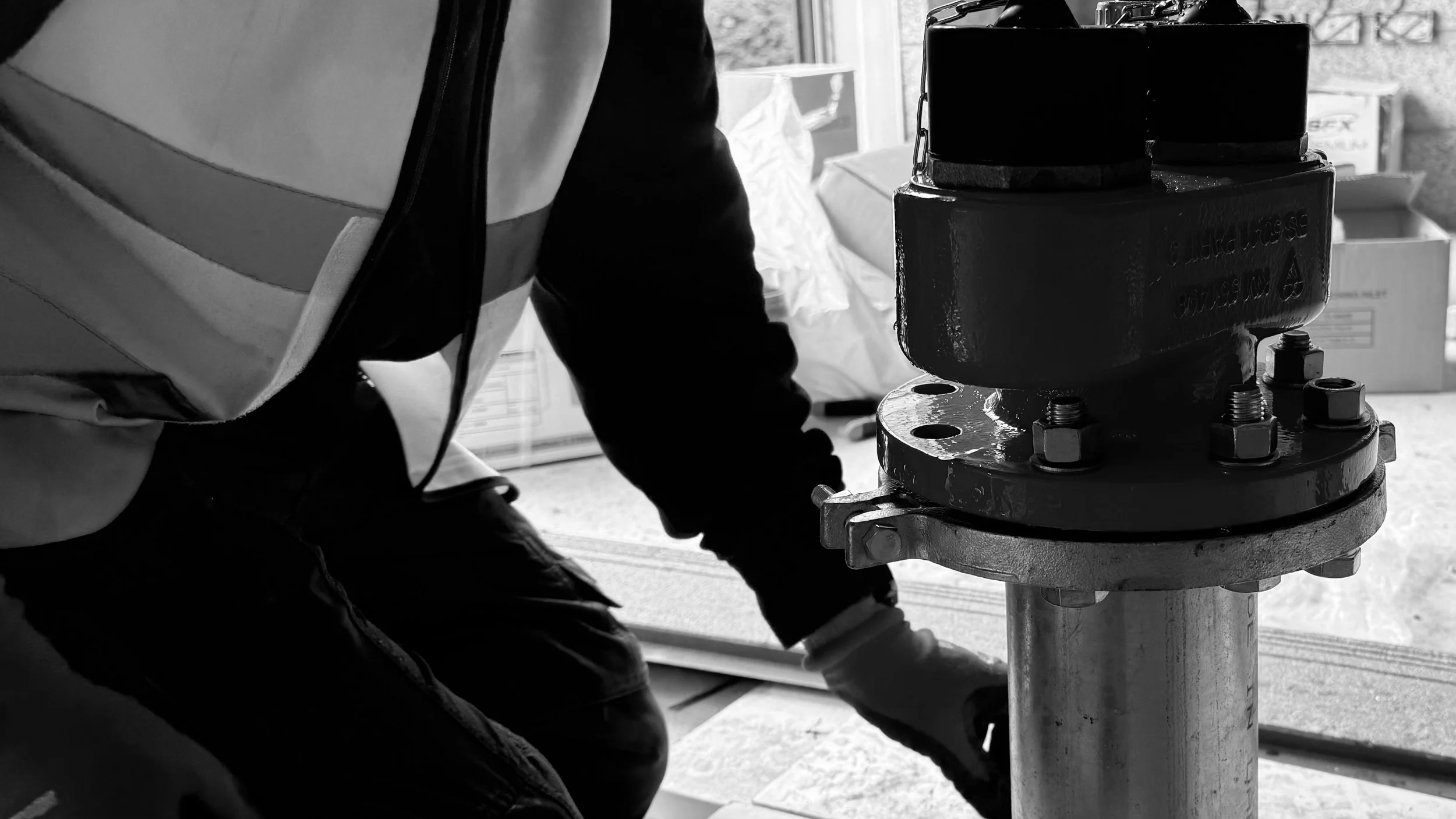
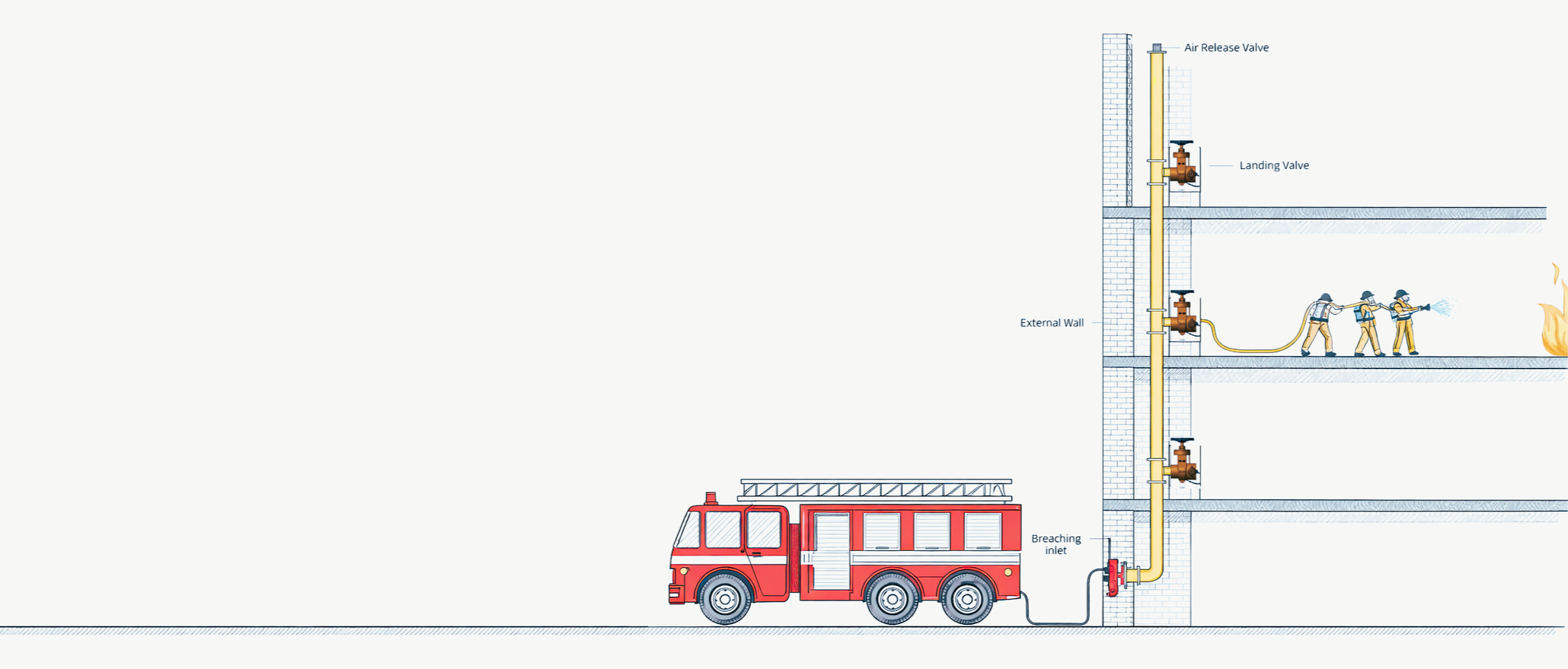
A dry rising main is a system of pipework and valves, often found in buildings over 18 meters high, which allows fire-fighting water to be easily delivered to all floors. The system is pumped with water from the fire appliance into the breeching inlet at ground floor level and distributed throughout the building.
Who installs Dry Risers?
Dry risers are a critical part of a building’s fire safety infrastructure, and their installation must be carried out by trained, competent professionals. Every installation team should be overseen by dedicated supervisor who holds a valid CSCS card and SSSTS certification, providing on-site leadership and ensuring all work is carried out in line with current regulations and best practices. All engineers have to undergo vetting process and should be subject to annual re-vetting to keep their skills, knowledge, and certifications fully up to date. This includes mandatory health and safety training and qualifications such as asbestos awareness, working at height, and other relevant industry certifications.
How to receive a Certificate of Compliance?
To receive a Certificate of Compliance for a dry riser installation, the client must first obtain approval from their local fire officer (FO) for the dry riser and its proposed location. Once approval is granted, a compliant design must be completed by a professional design team. After this, the client can formally instruct a dry riser contractor to carry out the installation. Upon completion, engineers install, test, and certify the system in accordance with BS 9990:2015, allowing the installation certification to be issued. The certification is valid for 12 months and requires a visual inspection six months after its commissioning to ensure the system remains compliant. All installations, testing, and certification should be carried out in accordance with BS 9990:2015, ensuring the dry riser system meets the required British Standard. Compliance with BS 9990:2015 provides assurance that the system is suitable for fire-fighting operations and fully aligned with current fire safety legislation.
Now that we understand the basics of dry riser installation, let’s look deeper into the installation process and what it involves.
Dry Riser Installation

Let’s understand the dry riser installation process.
01 Enquiry
02 Quotation
03 Site Survey
04 Installation
05 Handover
06 Certification
Advantages of a Dry Riser System
A Dry Riser System is cost effective compared to other fire suppression systems such as Sprinkler systems. Compared to sprinkler systems, dry risers are less intrusive as they are typically installed within a stair core or protected lobby. Since the system is empty under normal conditions there is no worry about unexpected leaks. This makes dry riser systems a practical solution for many building types while still ensuring rapid access to water for firefighting teams when needed.
Dry riser systems can be installed in a wide range of buildings, including:
Residential apartment blocks
Commercial offices
Hospitals and healthcare facilities
Hotels and hospitality buildings
Airports and transport hubs
Multi-storey car parks
Grade I and Grade II listed buildings
Public venues and large facilities
Their flexibility makes dry risers an essential part of fire safety in construction.
Dry Riser Installation Sequence
Liaise with site management to agree the programme of works and arrangements for the storage of materials.
Ensure all operatives are made aware of any live services or hazards within the working area. Confirm that all necessary safety procedures are in place before work commences. Obtain any permits to work as required by the site team and ensure that all site safety rules and regulations are followed at all times.
Install pipework and valves within the building in accordance with the construction programme and approved drawings. Measure galvanised steel pipework and cut to the required length using a suitable cold cut chop saw.
Groove the pipe using a roll grooving machine. Set the correct groove depth, operate the machine and apply steady pressure whilst rotating the pipe until the required groove depth is achieved. Once grooving is complete, remove the pipe and check that the groove is correctly formed and suitable to receive the required fitting such as an elbow, socket or tee. Pipework should be supported using suitable pipe supports such as filbows, tophats, Munson rings, wall brackets or floor brackets. The type of support used will depend on the structure to which the pipe is being fixed.
Pipework should be supported at intervals not exceeding 3 metres, or at every change of direction, whichever is the lesser. On the installation there can be cases when engineer is using 11 Degree, 22 Degree and 90 Degree bends to help the system to route around obstacles.
Install pipework in accordance with the drawings and specifications, ensuring that all landing valves and associated components are installed as required by the client's specification.
Once installation is complete, pressure test the pipework to confirm system integrity and carry out commissioning as required.
On completion of the works, hand over the installation to the client and complete the necessary documentation, including signing the job sheet.
Technical Submission
Landing Valves: Male-threaded landing valves provided to minimise the risk of unauthorised removal or theft.
Cabinets: Red Steel cabinets supplied and installed in accordance with BS 5041 Parts 4 and 5, complete with lockable access, wired glass viewing panels, and permanent identification signage.
Drain Valves: 25mm drain valves installed in accordance with BS 5041-3 to facilitate effective drainage of the rising main following system use.
Pipework: Galvanised steel pipework provided throughout, designed to meet the required operating pressure, durability, and long-term robustness of the system.
Signage: Fire mains and associated equipment clearly identified with appropriate dry riser inlet and outlet signage.
Air Vent: Automatic air release valves installed at the top of each vertical main.
Why choose Dry Riser One Ltd?
We value great communication and our expert teams provide dry riser installations for residential, commercial and high-rise buildings. We design and fit systems that meet all current regulations, ensuring your property is fully compliant and protected in the event of an emergency. With high quality materials, skilled engineers and a reliable service from start to finish, we make sure your dry riser is safe, effective and built to last.