
Health & Safety and PPE within Dry Riser One Ltd
PPE requirements
At the heart of every successful dry riser installation is not just technical precision but also an unwavering commitment to safety. Our engineers uphold the highest standards on every project, ensuring full compliance with BS/EN PPE requirements and site-specific safety regulations.
All our dry riser installation engineers are always equipped with five-point PPE while on site. This includes safety boots, protective trousers, hard hats, Cut Level 5 gloves, and Hi-Viz clothing. These items are mandatory and form a vital part of our safe working procedures, protecting our team against site-specific hazards and ensuring full compliance with national health and safety standards.
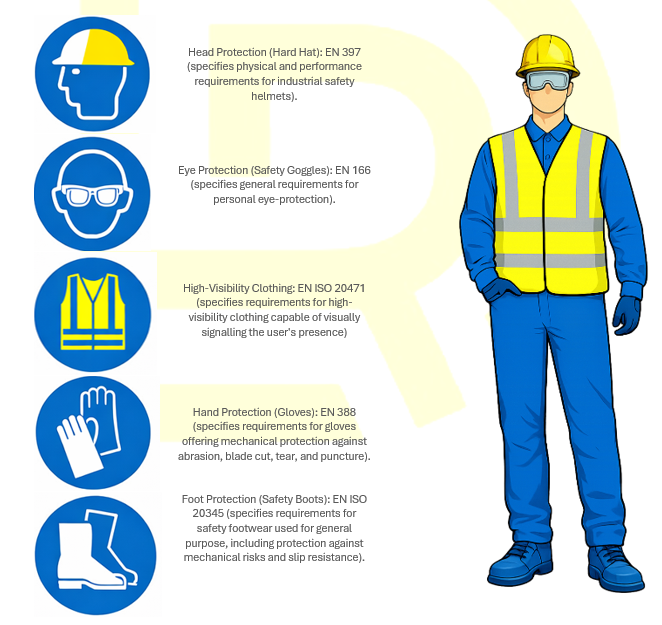
Site Specific Risk Assessment
While PPE (Personal Protective Equipment) is recognised as the last line of defence against potential hazards, our teams treat its proper use with the utmost seriousness. Every member of staff is required to wear the appropriate PPE as identified within the site-specific risk assessment, ensuring that no task is carried out without the necessary level of protection.
Eye protection and hearing protection are used as required, based on the environment and nature of the work being undertaken. On sites where noise levels are high or where there is a risk of flying debris, our engineers are equipped with certified safety glasses and hearing protection in accordance with BS/EN standards.
Face Fit Masks (FFP3) are sometimes mandatory on sites. Each engineer holds a valid certification confirming that they have been correctly fitted for their mask type. To ensure the masks function properly, engineers must remain clean shaven throughout the installation period. This is a vital safety measure that ensures the mask’s seal remains effective, providing full respiratory protection where required.
Our company takes pride in maintaining a robust safety culture across all dry riser installations. From the use of properly certified PPE to regular risk assessments and safety briefings, every precaution is taken to protect our team and those around them. All engineers are trained to the latest safety standards and understand that PPE is not optional.
Additionally, Cut Level 5 gloves must be used whenever handling tools, pipework, or sharp components, minimising the risk of cuts and abrasions during installation.
We believe that exceptional workmanship begins with exceptional safety. By ensuring our engineers are fully protected and properly trained, we continue to deliver dry riser installations that meet the highest standards of quality, compliance, and care.
Safety Signs
The objective of the Regulations is to provide a legal means requiring that safety signs comply with BS 5378 where signs are directed at people at work. More on safety signs please follow the link: https://www.hse.gov.uk/pubns/priced/l64.pdf
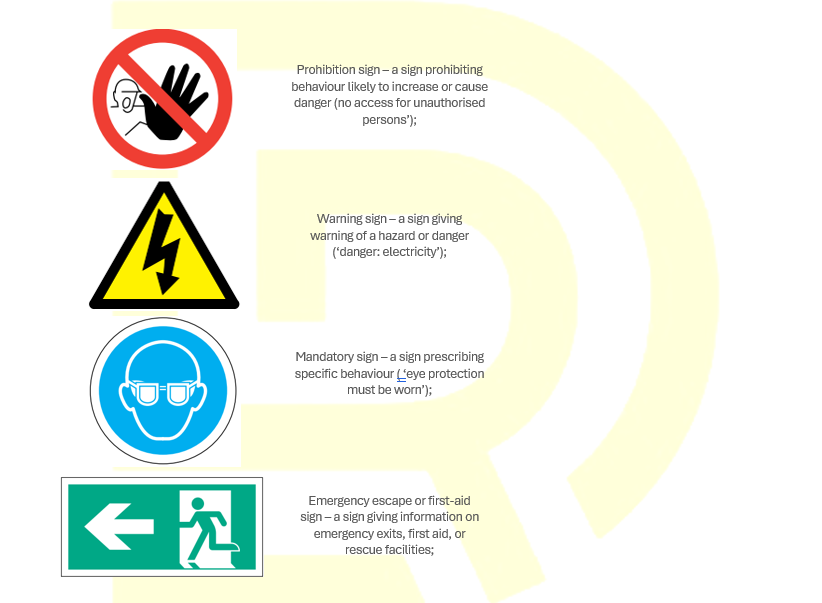
There are four kinds of safety signs as extracted from hse.gov.uk
Safety signs are defined as those combining shape, colour and a pictorial symbol to provide specific Health and Safety information or instruction. Regulations do not apply to road signs. Visual reminder included to reinforce the requirements in a simple and memorable way.
Safety Colour Red= Stop, Prohibition
Safety Colour Yellow = Caution, Risk or Danger
Safety Colour Blue= Mandatory action
Safety Colour Green = Safe condition
Looking Ahead
One of the most important aspects of working on site is working at height, which introduces additional risks and safety requirements. This topic is covered in our previous article: https://www.dryriserone.co.uk/news/dry-riser-installation-at-height