
Dry Riser Installation London – Hatton School, Ilford
Dry Riser One completed a dry riser installation in London for Hatton School and Special Needs Centre’s new Upper School site on Park Avenue in Ilford, IG1 4RS.
The dry riser works were completed through to successful commissioning and handover. The completed dry riser systems were tested to BS 9990:2015, with the handover certificate issued the following day and valid for one year from the installation date.
This case study shows how a dry riser installation should be approached in an education and special needs environment: with clear coordination, practical site decisions and a focus on compliance, safety and finish quality.
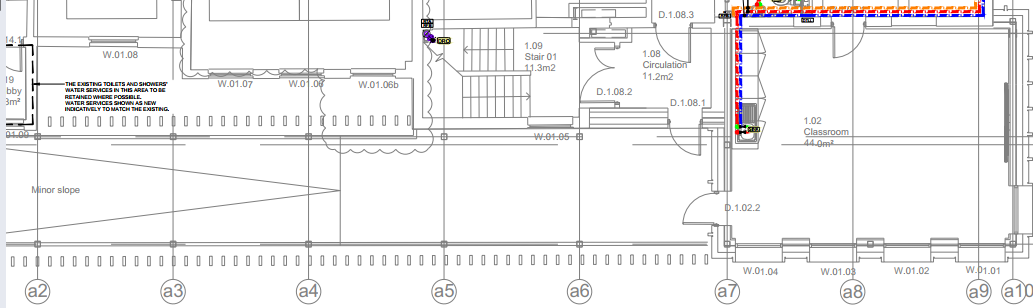
Dry Riser Installation London Ilford Architectural Drawing
Dry riser requirements are ultimately determined by the local Fire Officer, Building Control and the building’s fire strategy. Any dry riser system should be designed, installed, tested and maintained in accordance with the current published British Standard, BS 9990:2015. Even in some lower-rise or restricted-access buildings, a dry riser may still be specified where firefighters require a secure water supply and access is limited.
For the full guidance, please follow this link: British Standard BS 9990:2015
For education and public building environments, dry riser systems form an important part of the wider fire safety strategy. They give firefighters the infrastructure needed to access water supplies on upper levels quickly and effectively.
The new facility is opening in September and will accommodate Year 4 and Year 5 pupils, with a remodelled main building, secure recreation spaces and designated drop-off areas.
Project Details
Our completed dry riser installation covered Staircases 01, 03 and 05. The works included three dry riser systems, three breeching inlets and four outlet / landing valves.
The project drawings show the level of coordination required to deliver a clean and compliant installation. At ground floor level, the design included dry riser 2-way breeching inlets, stainless steel dry riser inlet architraves and doors, and drainage to ground floor.
The same drawing set also recorded local changes around the dry riser positions. This included moving one door by approximately 300 mm to make room for the equipment and providing boxing-in to the back of the riser where required.
On the upper levels, the installation continued through the building with landing valve provision coordinated around the staircase layout. The second-floor detail showed a typical landing valve arrangement above finished floor level.
In simple terms, this is what a planned dry riser installation in London should look like. The system was not treated as an afterthought. It was coordinated as part of the wider building layout so firefighters could use it effectively while the client still received a clean finished result.
Cabinet and Architrave Adjustment
According to the project brief, we were originally instructed to install full cabinets. However, once the site conditions were properly reviewed, it became clear that the required opening could not be achieved with a 275 mm wall depth.
Rather than forcing an unsuitable fit or creating a compromised finish, architraves were provided instead. This was the practical solution on site, allowing the installation to remain neat, workable and visually consistent, while reflecting the actual wall build-up available.
The other two doors were left on site to be installed once the wall build-up has been completed.
Stainless Steel Inlet Valve Door Specification
The project brief set a clear standard for the inlet valve doors. The required standard was “conforms to BS 5041 Part 4”, which aligns with the BSI standard for boxes for landing valves for dry risers.
The cabinet specification called for the finish to be in stainless steel satin polished finish, a 30 mm architrave all round, a Yale-type slam lock keyed alike, and a stainless-steel piano hinge.
In a school environment, these details matter. The finish needs to look presentable and remain durable.
Please see our full article on stainless steel here: Stainless Steel Cabinets.
Why This Dry Riser Installation Worked
What made this a successful dry riser installation in London, is not only that the system was installed, commissioned and certified, it is the fact that the dry riser engineers and the site team worked closely with strong communication throughout.
The drawings were detailed and highlighted the inlet and outlet locations with clear pipe routes. The certificate confirmed the installation and commissioning of the dry riser system conformed to BS 9990:2015. The site adjustment around the cabinets showed how experienced dry riser installers solve live project issues without losing control of compliance, usability or finish quality.
For anyone searching for dry riser installation in London, dry riser installers in London or dry riser alterations in London, this is the standard they should expect.
At Dry Riser One, we combine compliance, site coordination and finish quality so the final system works both on paper and on site.
We are also proud to be a five-star ⭐⭐⭐⭐⭐ Google-rated company, and we believe that reputation comes from getting the practical details right, especially when a project requires calm, site-based problem solving rather than a generic answer.
All advice is delivered in full accordance with BS 9990:2015. For further assistance, please contact us on +44 (0) 800 061 4111.
Follow us on Instagram for more site updates and examples of the projects we take on every day.
Sources:
