
Difference Between Dry Risers and Wet Risers
Dry Risers and Wet Risers in Modern Fire Safety
Dry risers and wet risers are essential fire protection systems used to deliver water throughout buildings during emergencies. Wet riser systems play a key role in fire protection in multi-story and high-rise buildings. Unlike dry riser systems, which are empty until they are filled with water during a fire emergency, wet risers are continuously pressurised and filled with water, ready to be deployed at a moment's notice. This ensures that firefighters can access water instantly and effectively, without waiting for water to be pumped into the system.
Wet riser systems are particularly suited for taller buildings where immediate access to water is crucial due to the challenges posed by height and water delivery distances. These systems are designed for buildings that exceed 50-metres, where the logistics of hauling hoses up multiple flights of stairs or using external hydrants become impractical.
Understanding Dry Risers and Wet Risers
Understanding dry riser and wet riser systems is essential when planning any dry riser installation in modern buildings. Similar to dry risers, wet risers also consist of a network of pipes with outlets on each floor. However, the key difference is that wet risers are constantly filled with water.
A dry riser is a pipe system that remains empty during normal conditions. In the event of a fire, the fire and rescue service connects a water supply to the breeching inlet valve and pumps water through the system to landing valves on each floor. For buildings between 18-metres and 50-metres, a dry riser is typically sufficient.
A wet riser operates differently as it is permanently filled with water from a dedicated supply. This allows immediate access to water during a fire without the need for external pumping. Wet risers are typically required in taller buildings where rapid response is critical and delays could significantly increase risk.
Key Features of Dry Riser Systems
One of the defining characteristics of dry riser systems is that they remain empty under normal conditions and are only filled with water during a fire emergency.
Simple and Cost-Effective Installation
Dry riser installation is simple and cost-effective, as they do not require a permanent water supply, pumps, or storage tanks. Because the pipework remains empty under normal conditions, the risk of internal corrosion, scaling, and leaks is significantly reduced. In addition, they provide flexible water supply during emergencies, allowing firefighters to connect to external sources such as fire engines or hydrants to ensure adequate pressure and flow for effective firefighting.
Dry Riser System and Its Maintenance
Dry riser systems are generally less complex than wet risers due to the absence of continuous water pressure and mechanical pumping systems. However, they still require regular inspection and maintenance to ensure reliability during an emergency.
A key aspect of dry riser maintenance is ensuring that all pipework remains clear and unobstructed. Any debris, corrosion, or blockages within the system could prevent water from flowing effectively when needed.
Inlet valves and landing valves must be routinely checked as per BS 9990:2015 to ensure they are fully operational and capable of forming secure connections with firefighting equipment. Damaged threads, worn seals, or faulty valves can significantly impact system performance during a fire.
Pressure testing is also essential to confirm the structural integrity of the system. This ensures that the pipework can withstand the high pressures applied when water is pumped into the riser during an emergency.
What Type of Valves for Dry Risers Should Be Considered
A typical dry riser installation consists of landing valves that are designed to withstand high-pressure water flow during firefighting operations. These valves are commonly manufactured from durable, corrosion-resistant materials such as gunmetal and are compliant with relevant standards such as BS 5041.
All valves should be installed with the correct orientation, ensuring ease of operation and accessibility for firefighters.
Key Features of Wet Riser Systems
One of the defining characteristics of wet riser systems is their ability to maintain a continuous supply of water where a dry riser system needs to be filled with water during an emergency. Wet riser pipes are kept always filled with pressurised water, meaning that as soon as firefighters access the system, water is immediately available for firefighting operations. This constant water presence offers advantages:
Instant Availability: Water is ready for immediate use, significantly reducing response time in an emergency.
Eliminates the Need for External Water Sources: Since the water supply is integrated within the building, firefighters do not need to rely on external water sources like hydrants or water tankers, making the system especially useful in urban areas where access to water can be limited.
Efficiency During Emergencies: In high-rise fires, every second is critical. Wet riser systems provide a constant pressurised water supply, enabling firefighters to act immediately and control the spread of fire.
How Complex is a Wet Riser System and Its Maintenance
While wet risers have significant advantages in terms of speed and readiness, they also come with added complexity and maintenance requirements. Due to the continuous presence of water, these systems need to be carefully maintained and regularly checked to prevent issues such as leaks, corrosion, or blockages.
One of the biggest challenges with wet riser systems is preventing the pipes from corroding due to the constant presence of water. Galvanised steel and other corrosion-resistant materials are commonly used in the construction of wet riser systems, but regular inspection and maintenance are necessary to ensure the integrity of the pipes over time.
The pumps that maintain water pressure in wet riser systems must be routinely serviced to ensure reliable performance. This includes inspecting pump seals, testing output, and confirming that backup systems such as generators or secondary pumps are fully operational in the event of a power loss or pump failure.
Since the pipes are continuously filled with water, it is essential to check for leaks or drips that can compromise the system's functionality. Leaks can lead to reduced water pressure and even water damage within the building. Additionally, the quality of the water must be monitored to ensure that it does not become contaminated or stagnant, which could lead to corrosion or health hazards.
What type of Valves for Wet Risers should be considered
Most considered valves should be pressure reducing valves. 65mm gunmetal high-pressure landing valve is adjustable, corrosion-resistant, BS5041 compliant, supports up to 25 bar, ensures outlet pressure, low restriction flow, durable sealing, and is hydrostatically tested for performance.
All valves shall be installed with the centreline in a vertical orientation and the handwheel positioned at the top. Flow direction must strictly follow the arrow cast on the valve body.
Pipework shall be thoroughly cleaned prior to installation to ensure it is free from debris, scale, or any foreign matter that could impair valve operation or cause damage.
The valves in wet riser systems need to be checked regularly to ensure they are operating smoothly. Since these valves are under constant pressure, they can wear out or become clogged, potentially causing issues during an emergency. Regular cleaning, lubrication, and testing are essential for ensuring their reliability.
Dry Risers vs Wet Risers: Key Differences Explained
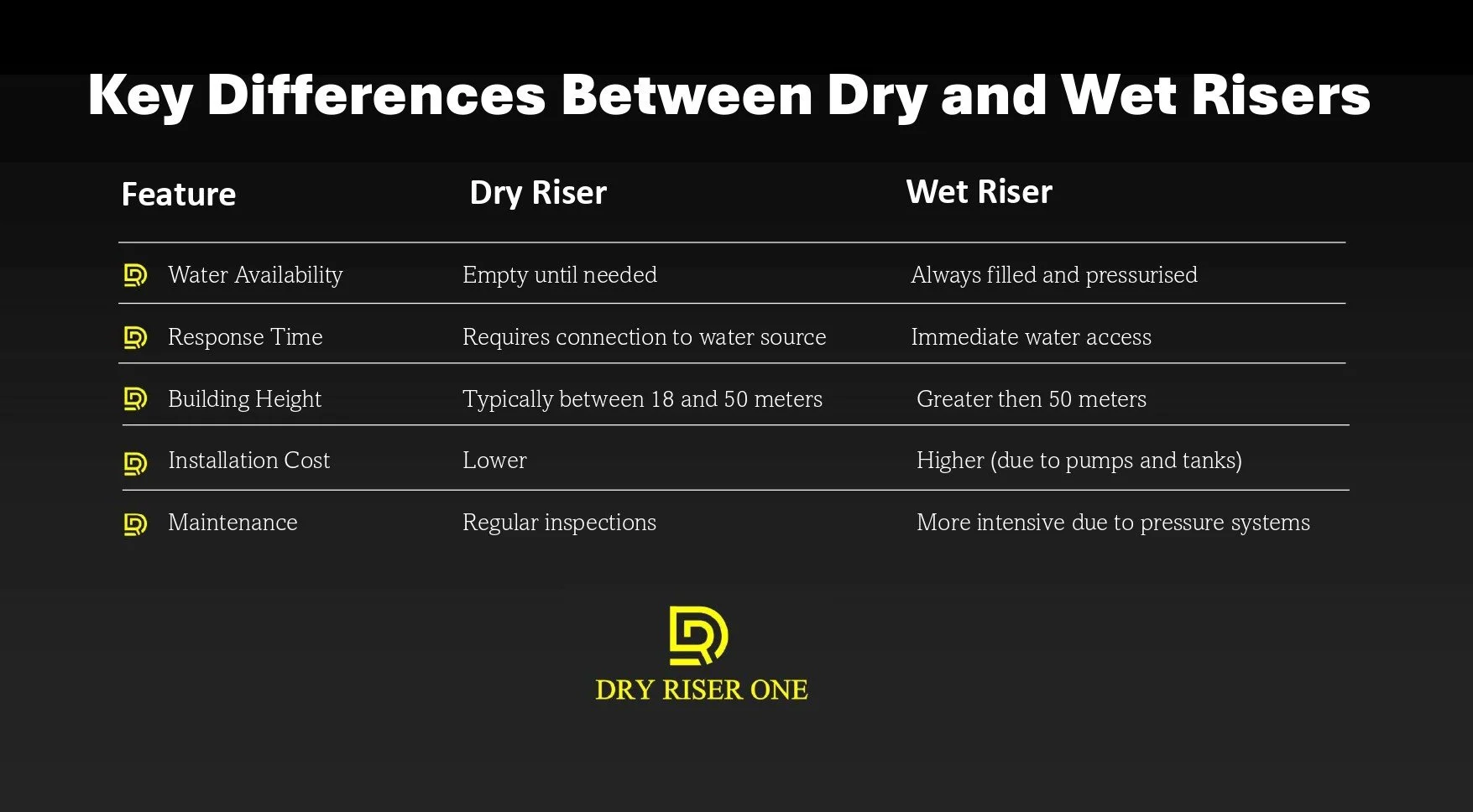
Dry and wet riser systems differ primarily in water availability, application, and complexity. Dry risers remain empty and rely on firefighters to connect an external water supply during an emergency. In contrast, wet risers are permanently filled with pressurised water, providing immediate access and are typically required in taller buildings over 50-metres where rapid response is essential. Wet risers involve higher installation and maintenance costs due to pumps and water storage systems, while dry risers are more cost-effective. Selecting the appropriate system depends on building height, risk level, and ensuring compliance with fire safety standards and regular maintenance.
Legal Responsibilities and Professional Support
Building owners, landlords, and facilities managers have a legal duty to ensure dry and wet riser systems comply with British Standards, including BS 9990:2015. Wet riser systems require frequent and thorough inspections. This includes checking all components, such as pipes, valves, pumps, and pressure gauges. Building managers should ensure that the system is inspected at least annually, and any repairs or maintenance work should be completed promptly to prevent failures during an emergency.
Failure to maintain a dry and wet riser system correctly can result in enforcement action and serious liability if the system does not perform during an emergency. Professional installation and ongoing servicing are essential to ensure systems remain operational and compliant.
Full guidance: https://knowledge.bsigroup.com/
Sources: